July 2025
In this issue:
- The Fix: Dissecting a recent comms stumble and how to learn from it.
- Read the Room: Analysing media narratives and what’s behind them.
- Eyes Up: Opportunities, tenders, and calls for input.
- On the Blog: Highlights from this month’s Don’t Verb Nouns posts.
- Worth Your Time: Smart reads we’ve bookmarked for you.
The Fix: How a well-meaning profile became a reputational risk
Heading a national institution isn’t easy at the best of times, especially when that institution is one of Australia’s leading universities. Right now, Genevieve Bell has a particularly tough gig as Vice Chancellor of the Australian National University.
And that’s on a normal day. Throw in a budget in the red and a plan to get it back into shape by cutting jobs and the role moves north of ‘difficult’ pretty quickly. Staff are, understandably, unhappy at not just the job cuts, but at how the process has been handled. One particular flashpoint is Professor Bell’s $1.1 million salary (a 33 per cent increase on her predecessor’s pay) and her decision to take a 10 per cent cut as a gesture of shared sacrifice.
So it’s safe to say that — rightly or wrongly — Professor Bell’s reputation and standing have taken a bit of a hit. Under such circumstances it’s natural to want to right the ship. Argue your case. Let people know you’re human.
Enter The Canberra Times.
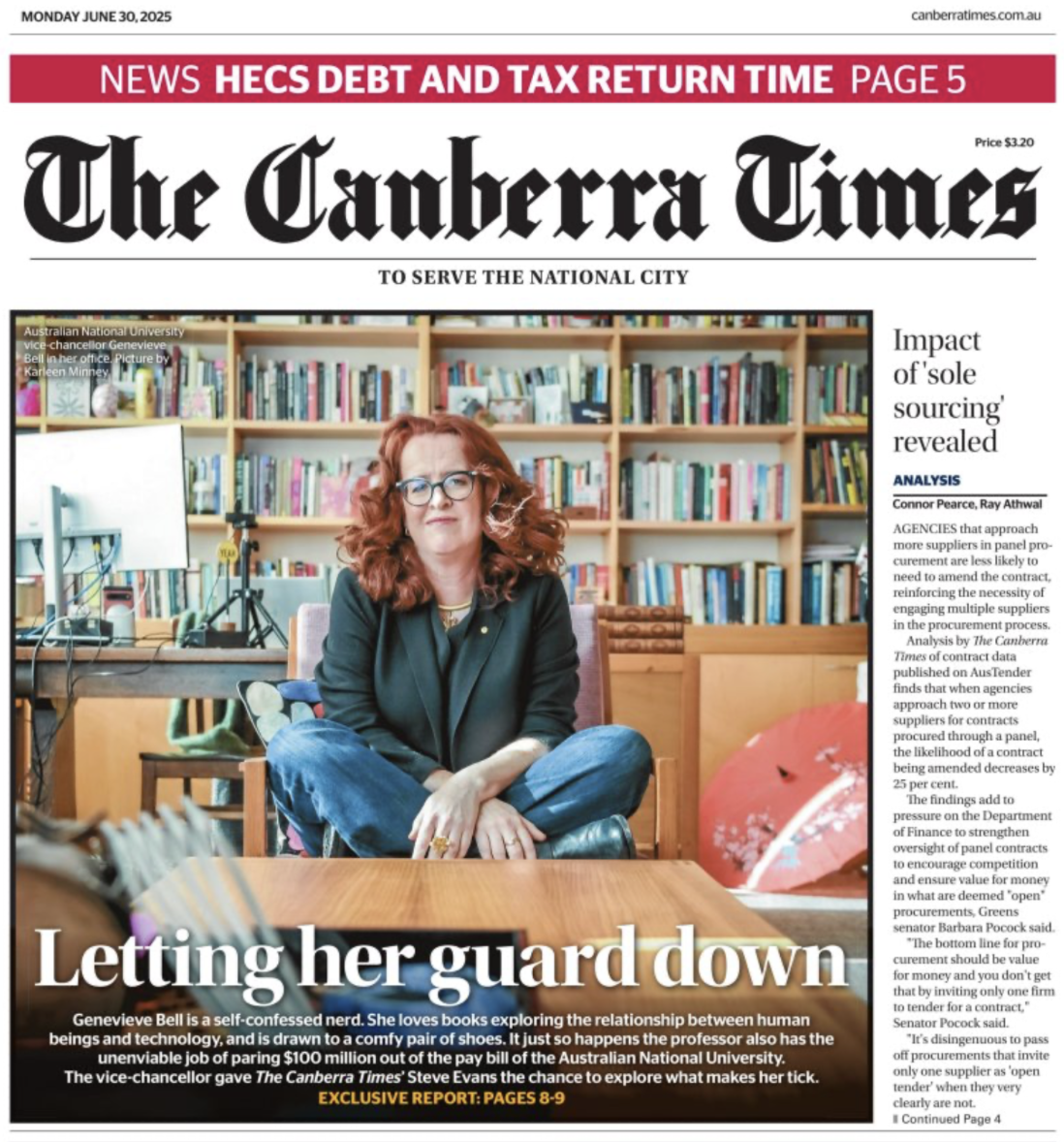
This week the Times published what can only be described as a puff piece on Professor Bell and let readers in on some pretty deep insights into the professor. Such as the fact that she likes expensive trainers. Or that she likes to edit Trove articles when she can’t sleep. Or that she’s waiting to be complimented by a newspaper.
It's safe to say the interview did not go down well, with some commentators seeing it as tone deaf amid staff lay-offs.
So how would we approach this?
The first step would be to ask: ‘Why are we doing this?’ Is it for reputation repair? Great, that’s a legitimate reason. Next question: ‘Who are we talking to?’ Is it the Canberra public? Politicians? Bureaucrats? Staff? Former staff? All of the above? That’s the unclear bit here.
More significant is the messaging (the ‘what’). If you were aiming to repair your image with any of the groups listed above, you’d want to address the rather large beast in the room. You'd want to demonstrate an awareness of the impact of your decisions on the institution currently under your stewardship, and the lives of the staff you employ. For $1.1 million a year, they want to see self-awareness and ownership of the process. They expect someone to ‘lean in’ and acknowledge the tough calls they’ve had to make. They probably don’t care about shoes.
Or if they do care about fashion choices, the place to discuss them isn’t in a reputation-repairing profile piece, but in other channels such as social media. That’s where a clear messaging plan — one that asks what are we saying, who are we saying it to, why are we saying it, and where — can help achieve your goals.
Read the Room: The Fin’s not-so-subtle campaign on super
It should surprise no-one that the Australian Financial Review is opposed to Labor’s plan to increase the tax on super balances over $3 million. What’s surprising is the sheer absence of shame in the Fin’s “coverage”. And when I say “coverage”, I mean campaign.
The Fin has been singing to the choir for months now over the tax change, with opinion piece after opinion piece warning that Jim Chalmers is on the brink of opening all seven seals and ushering in an apocalypse. It’s one thing to rant in clearly labelled opinion pieces, that’s part of the remit. But the Fin works its campaign into its general reporting as well. That blurring of lines is on full display in this news article on Chalmers’ Press Club speech, which opens with:
“Treasurer Jim Chalmers has refused to budge on his controversial plans to raise taxes on people with more than $3 million in superannuation, even as he signalled he was open to cutting income taxes as part of wider tax reform.”
Words matter. From the opening line, the article frames the Treasurer’s position as obstinate and embattled. But “refused to budge” — from what? And “controversial” to whom? Fin readers? That’s a narrow lens, given Labor’s 94-seat Lower House majority.
“Controversial” is a journo’s get-out-of-jail word because as as long as someone, somewhere, objects, it’s fair game. And “refused to budge” carries the whiff of editorial frustration: not reporting a position, but criticising it.
There’s plenty more in the Fin’s campaign against the reform. But it’s a timely reminder that not all opinion is clearly labelled. When reporting leans on loaded language, the bias reveals itself.
Eyes Up: Jim Chalmers wants your ideas
Submissions are now open for the government’s upcoming Economic Roundtable, to be held at Parliament House from 19–21 August. The government wants to hear ideas on improving productivity, building economic resilience, and strengthening budget sustainability.
Submissions are open until 25 July, but Treasurer Jim Chalmers has made it clear they need to be in the national interest, budget-neutral (or positive), and practical.
We wrote a piece on how to approach the task on the Stonefruit blog, Don't Verb Nouns.
On the blog: Views from Don’t Verb Nouns in June
Productivity is not a serving suggestion
The Treasurer has been crystal clear: productivity is at the core of Labor's agenda for this term. Here's how to pitch ideas the government will actually hear.
Media literacy is finally in the curriculum. It should be in your comms plan too.
Media literacy is no longer a nice-to-have, it’s a critical skill for anyone engaging with the public, especially as misinformation rises and trust in institutions falls.
Worth Your Time: What's keeping us occupied
Monocle has published its latest Quality of Life Survey 2025 and listed its 10 most liveable cities in the world. The somewhat Euro-centric list does have a few surprises.
As the debate over the use of artificial intelligence in the media continues, Columbia Journalism Review asks if such tools meet journalistic standards.
Following the news is hardly all fun and games at the moment. But how do you keep yourself informed and sane at the same time? The Conversation has some suggestions.
Been forwarded this email and like what you see? Subscribe here to get Between the Lines in your inbox every month.