March 2026
In this issue:
- Read the Room: Why a gas industry op-ed in the AFR is less about persuasion and more about how messages move through government.
- Eyes Up: Open consultations on cultural policy, graduate employment, housing inequity and bushfire preparedness — and where to have your say.
- Worth Your Time: A closer look at the Australia–EU trade deal, a quietly brilliant independent bookshop, and the return of Northern Exposure.
Read the Room: The medium is the message
An op-ed in the Australian Financial Review arguing against higher taxes on business is not, on the face of it, especially remarkable.
Samantha McCulloch’s recent op-ed on gas taxation is a case in point. The head of the oil and gas industry’s lobby group (Australian Energy Producers) recently argued that poorly designed taxes risk discouraging investment in gas.
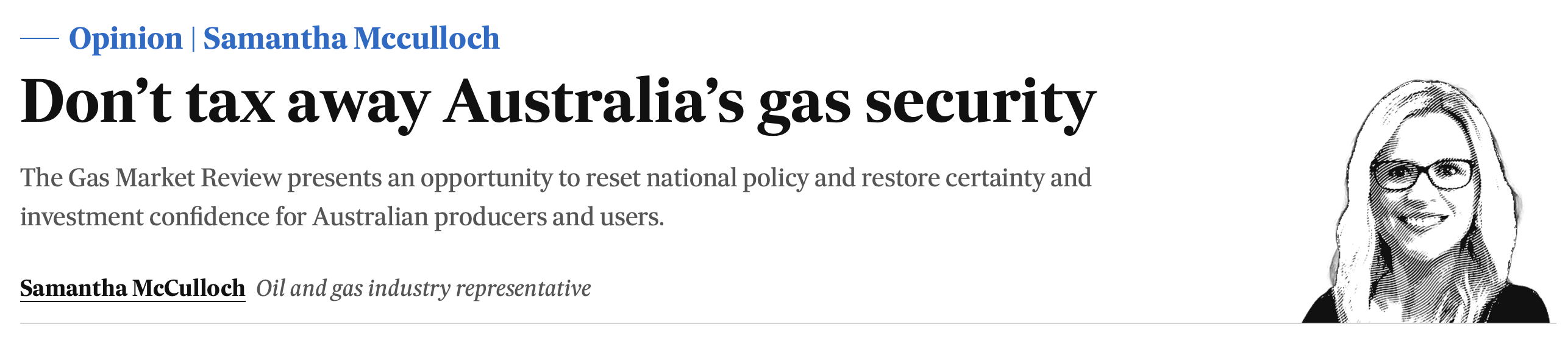
A business leader writing that taxes on business are a “Very Bad Thing” falls squarely into the “dog bites man” zone of newsworthiness. And since the
So what’s the point of all those column inches? Because residents of the country’s mahogany-lined offices are not really the intended audience. Well, not directly. The real audience is government.
Pieces like McCulloch’s get read into ministerial briefings, picked up in stakeholder summaries, and absorbed into the broader policy conversation. They help frame how advisers and officials understand an issue when they’re shaping decisions behind the scenes.
Seen through that lens, the op-ed is doing something far more deliberate than simply expressing a view.
First, it acts as a message anchor by placing a clear, defensible position into a credible public forum. Once it’s there, the argument moves from being sector scuttlebutt to something publicly articulated and able to be referenced.
Second, it becomes a repository of talking points. The language is distilled into a set of reusable frames — “investment confidence”, “energy security”, “reliable trading partner”, “supply shortfalls”. These are phrases that travel well and can be lifted into briefing notes, submissions, media comments, and stakeholder conversations with minimal translation.
Third, it provides a credibility vehicle. Appearing in a publication like the AFR lends weight to the argument, signalling that this is a serious, economically grounded position; one that sits comfortably within mainstream business thinking.
That’s the immediate function. What happens next is where it becomes more interesting.
In the days following the op-ed, similar arguments began to surface elsewhere. Comments reported in the AFR from the Business Council of Australia emphasised the importance of maintaining Australia’s reputation as a “reliable trading partner” and warned against policy settings that might undermine investment. Corporate leaders pointed to the need to consider “second-round effects” — growth, jobs, and broader economic impacts — rather than focusing narrowly on revenue.
Coverage in the Guardian captured the same core themes from multiple directions. David Pocock and the Australian Greens were arguing for higher taxes on gas exports, framing the issue around fairness and cost-of-living pressures. In response, industry representatives — including McCulloch — reiterated warnings about investment, supply, and price impacts. The Chamber of Minerals and Energy WA raised concerns about sovereign risk and Australia’s attractiveness as a place to invest.
The direction of those arguments differs, but the underlying point holds: the same core frames — investment, reliability, supply, economic impact — are doing the work across the debate.
This is the mechanism in action.
The op-ed helps place a set of arguments into circulation. From there, they begin to appear across different voices and forums: industry bodies, business groups, corporate leaders, and political figures. Not necessarily through coordination, but because they are drawing on the same framing and language.
For the government, the effect is cumulative. Instead of hearing a single organisation making a case, ministers and advisers encounter similar arguments from multiple directions. They see them reflected in media coverage, repeated in stakeholder engagement, and embedded in submissions and briefings.
Over time, the argument starts to feel less like advocacy and more like the ambient view of the sector. That is, it becomes the baseline position that needs to be engaged with, rather than one perspective among many.
There is also a second audience at play.
As the head of an industry body, McCulloch is not only speaking to government. She is also speaking to members — companies operating within the sector who expect their interests to be represented clearly and publicly. The op-ed signals that the organisation is active, engaged, and advancing a coherent position. It provides language that members can adopt in their own communications and reinforces a shared framing of the issue.
The op-ed undoubtedly sits alongside a broader mix of activity by the industry — direct engagement with ministers and officials, formal submissions, industry briefings, and ongoing media commentary. It’s one visible element of a wider effort to shape how the issue is understood and debated.
Which brings it back to where we started. On the surface, this looks like a straightforward piece of thought leadership: an industry leader setting out their position in a major publication.
But in practice, it’s closer to Marshall McLuhan’s observation that “the medium is the message”. Not because the content doesn’t matter, but because the medium determines what the message can do. An AFR op-ed doesn’t just express a view. It places that view into circulation in a form that can be picked up, repeated, and reinforced across the policy process.
In that sense, the op-ed isn’t so much the message as the mechanism that helps the message travel.